
The Time Machine Review
I often eschew from thinking about the passage of time due to it making me anxious about both the time I have wasted and the uncertainty around how I’ll waste time in the future. In what’s likely an exposure therapy strategy that no mental health professional would recommend, I decided to continue my literary classic novella reading-journey by reading H.G. Wells’s The Time Machine.
It’s all chrome! Ain’t no way!
Having only read a couple of science fiction books in the past, I looked forward to reading the work of someone revered as a pioneer of their genre. To his credit, Wells marvelously generated a fascinating future world that was simple yet intricate by utilizing effective imagery and subtle horror. Furthermore, I believe his two most impressive feats stood above the rest: imaginatively creating these future environments with likely few to no references outside of religion or the personal prognostications of the local loon to influence or guide him on what the Earth may appear like after many millennia have passed and writing text that stays captivating despite consisting predominantly of one man’s monologue. Our time traveler is a bit of yapper, but who wouldn’t be after witnessing giant crabs and sexy oompa-loompas.
Wells deserves credit for subverting expectations throughout the story as well. At first, I thought the relationship between the Eloi and Morlocks was a metaphor for the relationship between the proletariat and bourgeoisie of his time and the after effects of Great Britain’s Industrial Revolution. It likely was, but I admired the shift in the power dynamic as the story picked up. In the first half, I also incorrectly assumed there was going to be praise for or criticism against a woke communist utopia. Aside from politics, I was disappointed to learn the short kings, AKA Homo floresiensis, were not in fact ruling the world. At least Wells unintentionally dubbed the main Eloi character with a hilarious sophomoric name in Weena. Not only did it remind me of one of my favorite bands in Ween, but it also made me envision a Family Guy bit with Peter Griffin as the time traveler saying the following line, “This is like that time I time traveled eight hundred thousand years in the future: Okay, I’m going to name you Weena! Heheheheheh! Weena!”
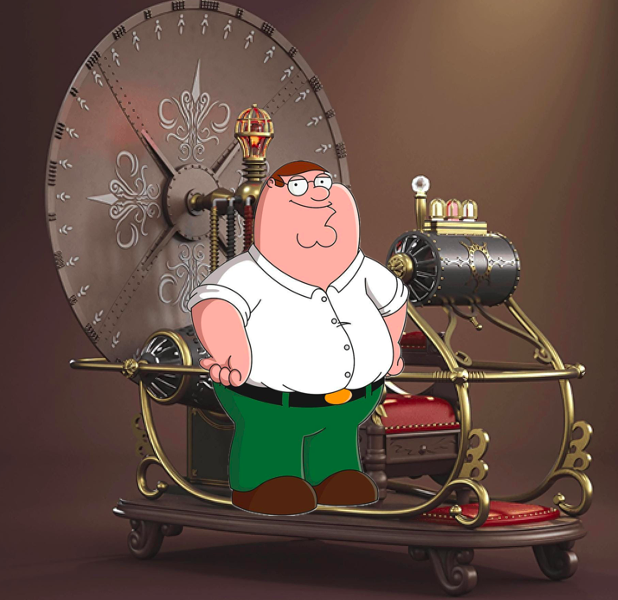
“Holy Crap Lois! I just farted in the year 800,000!”
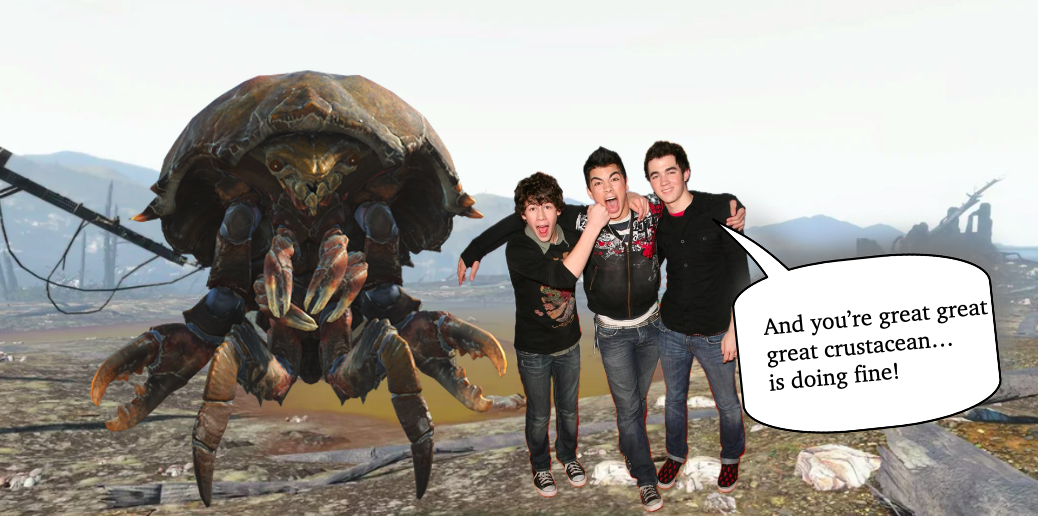
I also appreciated analyzing the work with a 2026 lens. Personally, I was astounded as I connected several of the qualities belonging to the various fictitious societies (including the crabs) hundreds of thousands of years in the future to our current one. Wells’s motifs may have predicted a general idea of our society’s direction or perhaps, we’ve been on this course for a while and it’s easy to symbolize that with subterranean monkeys. Either way, it’s concerning to think about whether our descendants will become tech-obsessed, dark-mode-using, photophobic cannibals or their naïve, TikTok dance-trend-chasing, critical-thinking-avoidant cattle. (You probably have to be rich to be in the former and beautiful to be in the latter, so the future generations of Ev Dog will be extinct by then!) Fortunately, or unfortunately, depending on your mindset, I don’t think there’s any way we as a species or our evolved deviant cousins make it to the year 800,000 let alone the year 3000. (Sorry Jonas Brothers!)
Like any of my reviews that start with overt lauding and pontificating on the future of our ever-deteriorating society, I eventually have to list out my primary criticisms as well. I mentally prepared for 19th century English writing, but too often the prose became rigid. Admittedly, I do not possess an immense lexicon, but I frequently had to mark my spot on a page with my Don’t Worry Be Capy bookmark featuring a sunglasses-wearing capybara in order to research the meanings of several different architectural terms, adjectives used to describe landscapes, and old-timey phrases that were probably outdated by 1907. (Although, I might start using “to and fro” fo sho.) I’m a fan of a good old-fashioned cliffhanger, but when nearly every paragraph (not just those at the end of a chapter) feels like it concludes with a suspenseful withholding of information that’s revealed in the first two sentences of the next paragraph and not even that vital to the plot, it gets old quick. Additionally, for this easily distracted, short-attention-span-having-reader, there were also a few uneventful scenes that idly meandered on for too long. I understand it sets up a more thrilling climax, but a couple more scenes centered around intense action and horrifying creatures straight out of a Fallout game would have considerably enhanced my engrossment with The Time Machine.
Despite its faults, I still enjoyed my time (sorry!) with this work and I’m eager to read more of Wells’s catalogue filled with pillars of the science fiction genre in the future. Now, I may take a brief hiatus from the blog to work on my own time machine in hopes of traveling to a dystopic future governed by an Authoritarian state that finally appreciates and is devoted to the teachings of Ev Dog Blog or maybe just 2010 when blogs were a more popular medium.